
Words THOMAS OPSTRUP
Photos THOMAS OPSTRUP
NERELLO MASCALESE


Nerello Mascalese is one of Sicily’s great indigenous grape varieties, and the variety most closely associated with the wines of Mount Etna.
Its history is deeply rooted in eastern Sicily. The name Nerello is generally linked to the Sicilian nero, referring to the dark colour of the grape, while Mascalese is traditionally associated with the area around Mascali, on the eastern side of Mount Etna.
Modern genetic research has revealed another layer to its history. Nerello Mascalese is the natural offspring of Sangiovese and the Calabrian variety Mantonico di Bianco — a reminder that even ancient varieties have stories shaped by movement, cultivation and generations of farmers.
Over centuries, Nerello Mascalese adapted to the particular conditions of Etna: intense Mediterranean sunlight, cool nights, limited water and soils formed from successive volcanic eruptions. The result is a grape capable of producing wines that combine freshness and structure with remarkable delicacy.
Etna is a mountain of contrasts.
The days can be intensely warm and bright, while temperatures fall considerably after sunset. The volcanic landscape is equally varied. Different eruptions have created layers of lava, ash, pumice and volcanic sand over thousands of years, producing soils that can change dramatically from one vineyard to another.
Nerello Mascalese responds strongly to these differences.
Altitude, exposure, soil and climate all influence the character of the finished wine. This is one of the reasons Etna has become such a fascinating wine region: the same grape can produce remarkably different wines from one part of the volcano to another.
The grape also ripens relatively late and naturally retains high acidity. On Etna, this can create wines with energy and freshness rather than simply weight and power.
Nerello Mascalese is often compared with Pinot Noir.
The comparison makes sense, not because the two grapes taste identical, but because both are capable of producing wines in which place matters more than sheer power.
Nerello Mascalese can be pale and transparent in colour, yet surprisingly structured on the palate. Aromas may include red cherries and wild berries, roses and violets, herbs and spices, together with earthy, smoky and mineral notes.
With age, the fruit can give way to more complex notes of tobacco, leather, dried herbs and earth.
Its tannins can be firm but fine-grained, while the natural acidity gives the wine freshness and length.
This combination of delicacy, structure and longevity is one of the reasons Nerello Mascalese has attracted increasing attention from wine lovers around the world. Etna wines are now frequently discussed alongside some of Italy and Burgundy’s more elegant reds.
"The vines experience strong Mediterranean sunlight during the day, while the influence of Etna brings cooler air after sunset."


One of the most remarkable aspects of Etna's vineyards is the survival of very old vines.
Traditional vineyards are often planted using the alberello or bush-vine system, with individual vines standing independently rather than being trained along modern trellises. This ancient method remains an important part of Etna's viticultural heritage.
In some parts of Etna, very old ungrafted vines have also survived. The sandy volcanic soils of certain areas provided natural protection against phylloxera, allowing vines on their original root systems to survive for generations.
These old vines are valuable not simply because of their age. Their survival represents a continuity of cultivation that has become increasingly rare as traditional vineyards have disappeared or been replaced.
They are living records of the landscape.
Our vineyards lie near Motta Sant'Anastasia, on the southern side of the Etna landscape.
Here, the character of the land is somewhat different from the high-altitude vineyards that have become the international image of Etna. The terrain around Motta is shaped by older volcanic formations, with weathered basalt and clay-rich soils, and the landscape gradually opens towards the plains below.
The vines experience strong Mediterranean sunlight during the day, while the influence of Etna brings cooler air after sunset.
These conditions suit Nerello Mascalese particularly well.
The vines have to work for water in a dry and stony environment. Production can be naturally limited, but the challenge is part of what gives the grapes their character.
For us, this is important. We are not trying to make a wine that could have come from anywhere.
We want the Nerello Mascalese to retain a sense of where it was grown.
Much of the traditional agriculture around Motta Sant'Anastasia has changed over the generations. Old vineyards have disappeared, land has been abandoned or converted, and the way people work the countryside has evolved.
Yet some of the old vines remain.
Our Nerello Mascalese is part of that continuity.
The oldest plants are not simply agricultural assets. They are part of a landscape shaped by generations of Sicilian farmers who understood how to work with difficult ground, limited water and an unpredictable volcano.
Today, we are continuing that work in our own way.
Nerello Mascalese does not need to be made into something it is not. Its strength lies in its ability to express the place from which it comes — the sun, the stone, the wind, the altitude and the long history of Etna.
That is what makes it one of Sicily's most distinctive grapes.
And that is why, for us, Nerello Mascalese is not simply a variety.
It is the soul of the land.
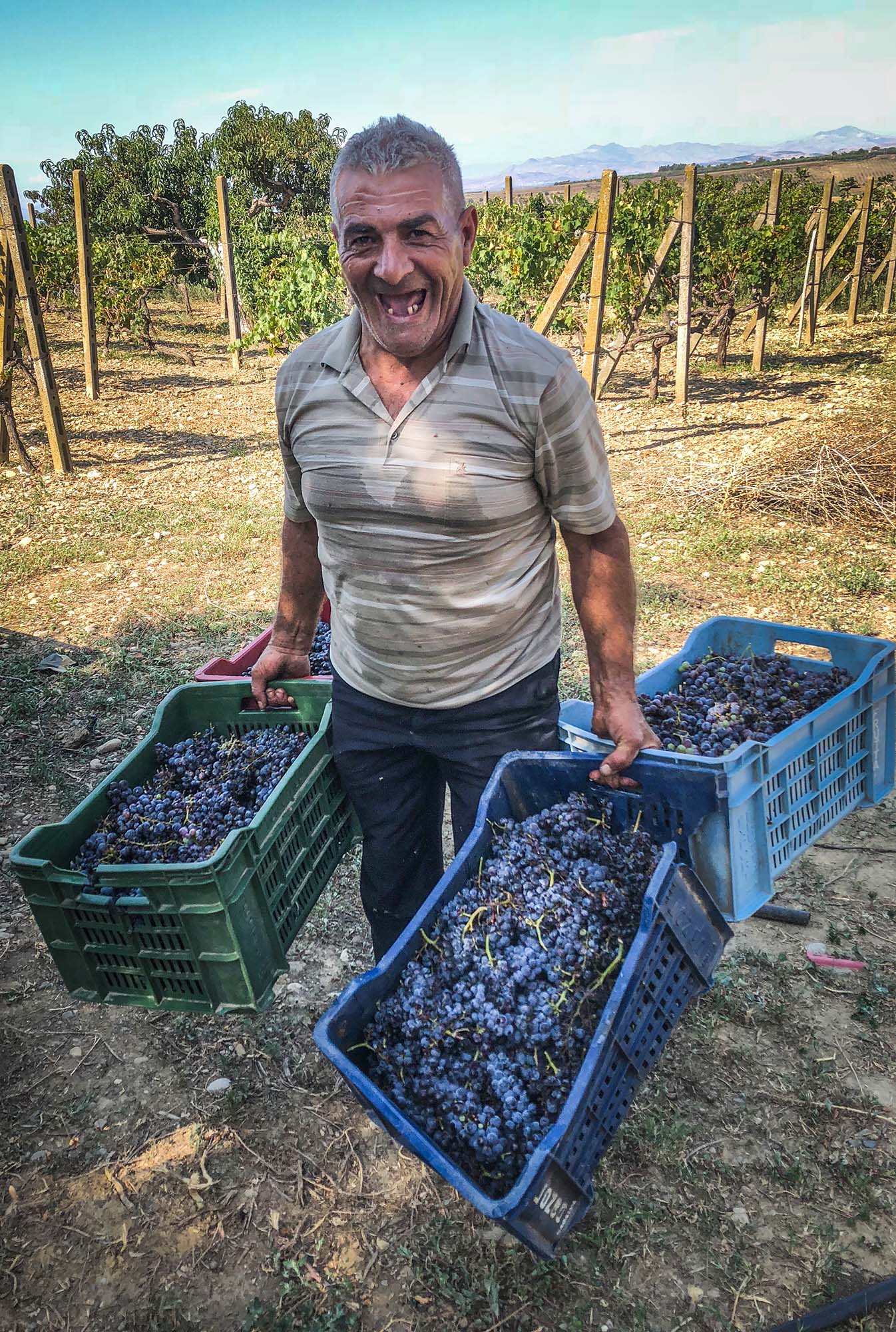
"The vines have to work for water in a dry and stony environment. Production can be naturally limited, but the challenge is part of what gives the grapes their character."

N° 1, Agriculture & Craft
OLIVE OIL
The difference between an ordinary oil and a truly exceptional one begins long before the bottle reaches the table.
Take a look at our other journal entries

N°2, Culture & Terroir
THE VOLCANO
Our vineyards are shaped by Etna that has been creating, destroying and renewing this land for thousands of years.

N°4, Culture & Terroir
MOTTA SANT'ANASTASIA
The place we chose as our home – a quiet Sicilian town with deep roots, authentic character and a unique connection to the land.